f1 :: Int -> Int -> Intf1 a b = a + b f2 :: Int -> (Int -> Int) f2 a b = a + b f3 :: Int -> (Int -> Int) (f3 a) b = a + b f1 == f2 == f3
Beispiel
twice :: (a -> a) -> a -> a twice f x = f (f x) > twice (*2) 1040
Funktionen höherer Ordnung für Listen
map :: (a -> b) -> [a] -> [b]
map f xs = [f x | x <- xs]

> map even [1..5]
[False, True, False, True, False]
filter :: (a -> Bool) -> [a] -> [a]
filter p xs = [x | x <- xs, p x]

> filter even [1..10]
[2, 4, 6, 8, 10]
> all even [2, 4, 8] True> any odd [2, 4, 9] True> takeWhile even [2, 4, 7, 8] [2, 4] > dropWhile even [2, 4, 7, 8] [7, 8]
Strukturelle Rekursion
Bekanntes Muster für Rekursion über Listen:
f [] = v f (x:xs) = x # f xs sum [] = 0sum (x:xs) = x + sum xs product [] = 1product (x:xs) = x + product xs
Wird zu
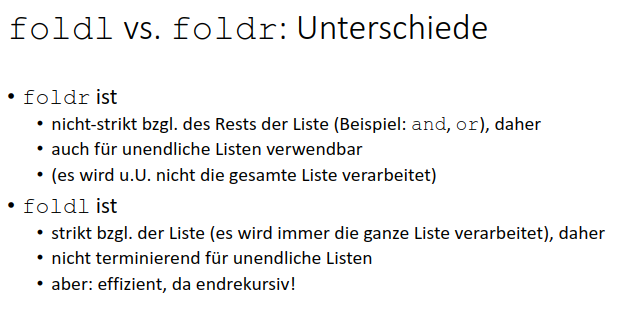
sum :: Num a => [a] -> a sum = foldr (+) 0product :: Num a => [a] -> a product = foldr (*) 1foldr :: (a -> b -> b) -> b -> [a] -> b foldr f v [] = v foldr f v (x:xs) = f x (foldr f v xs)