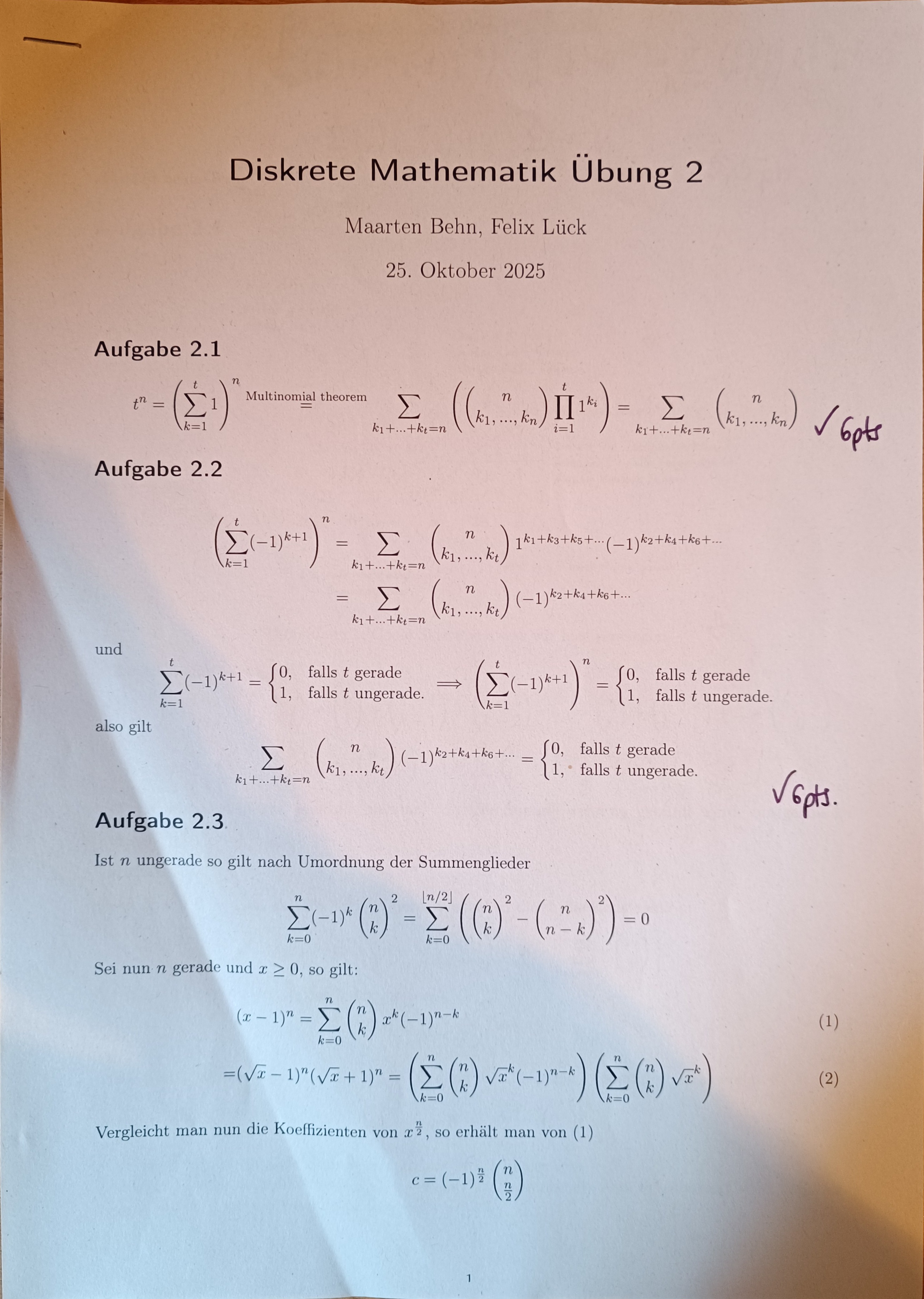
If we set x1,...xt=1 (x1,+...+xt)n becomes (11,+...+1t)n=tn k1+...+kt=n∑(k1,...,ktn)x1k1,...,xtkt becomes k1+...+kt=n∑(k1,...,ktn)11k1...1tkt=k1+...+kt=n∑(k1,...,ktn)
2.2
Show
k1,...,kt∑(−1)k2+k4+k6+...(k1,...,ktn)={0 1 if t is even,if t is odd.
x1k1x2k2x3k3,...=1k1(−1)k21k3,...=(−1)k2+k4+k6+...k1+...+kt=n∑(−1)k2+k4+k6+...(k1,...,ktn)=(1−1+1−...)n={(0)n(1)nif t is even,if t is odd.
For all n>0
2.4
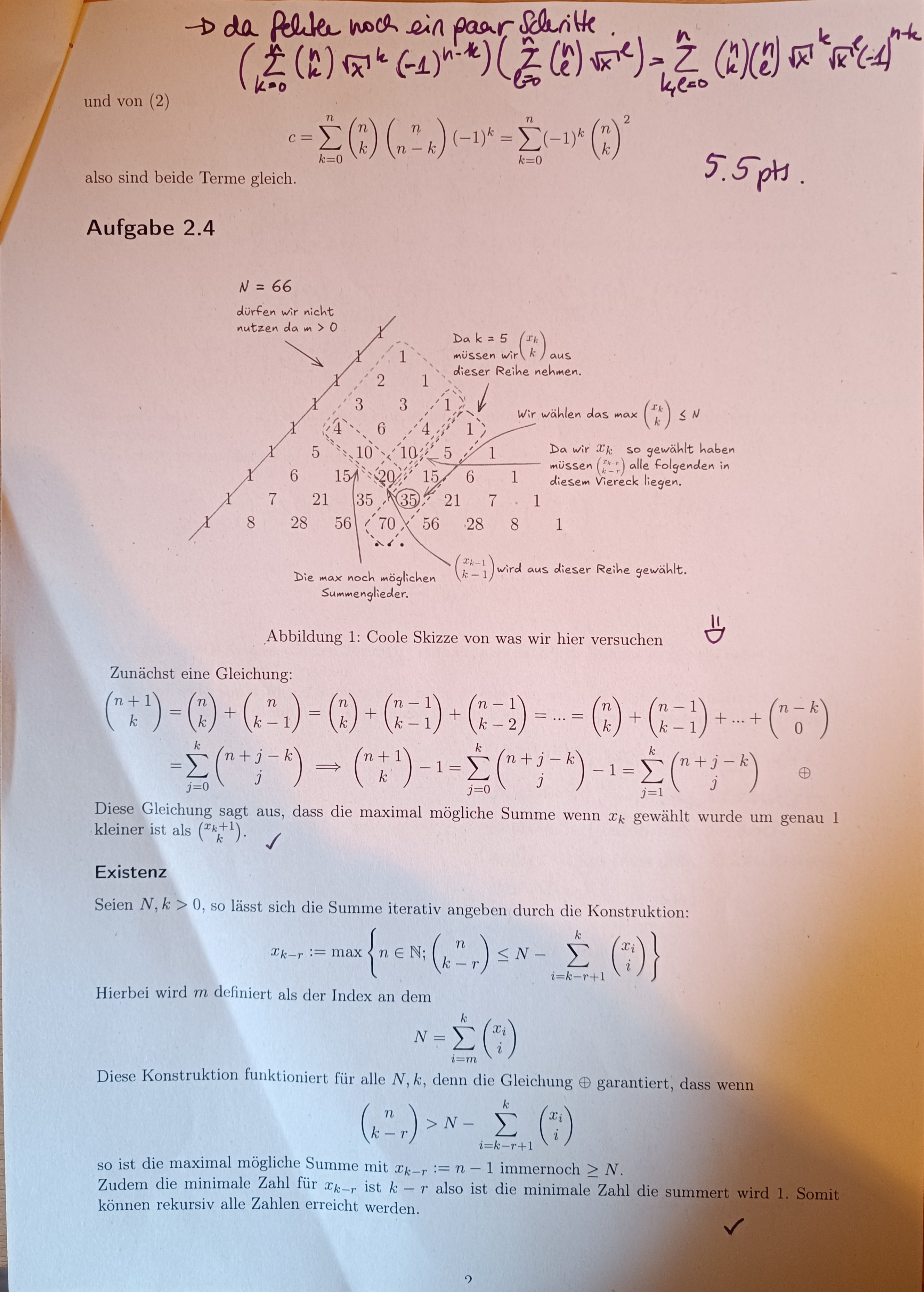
Let k and N be positive integers.
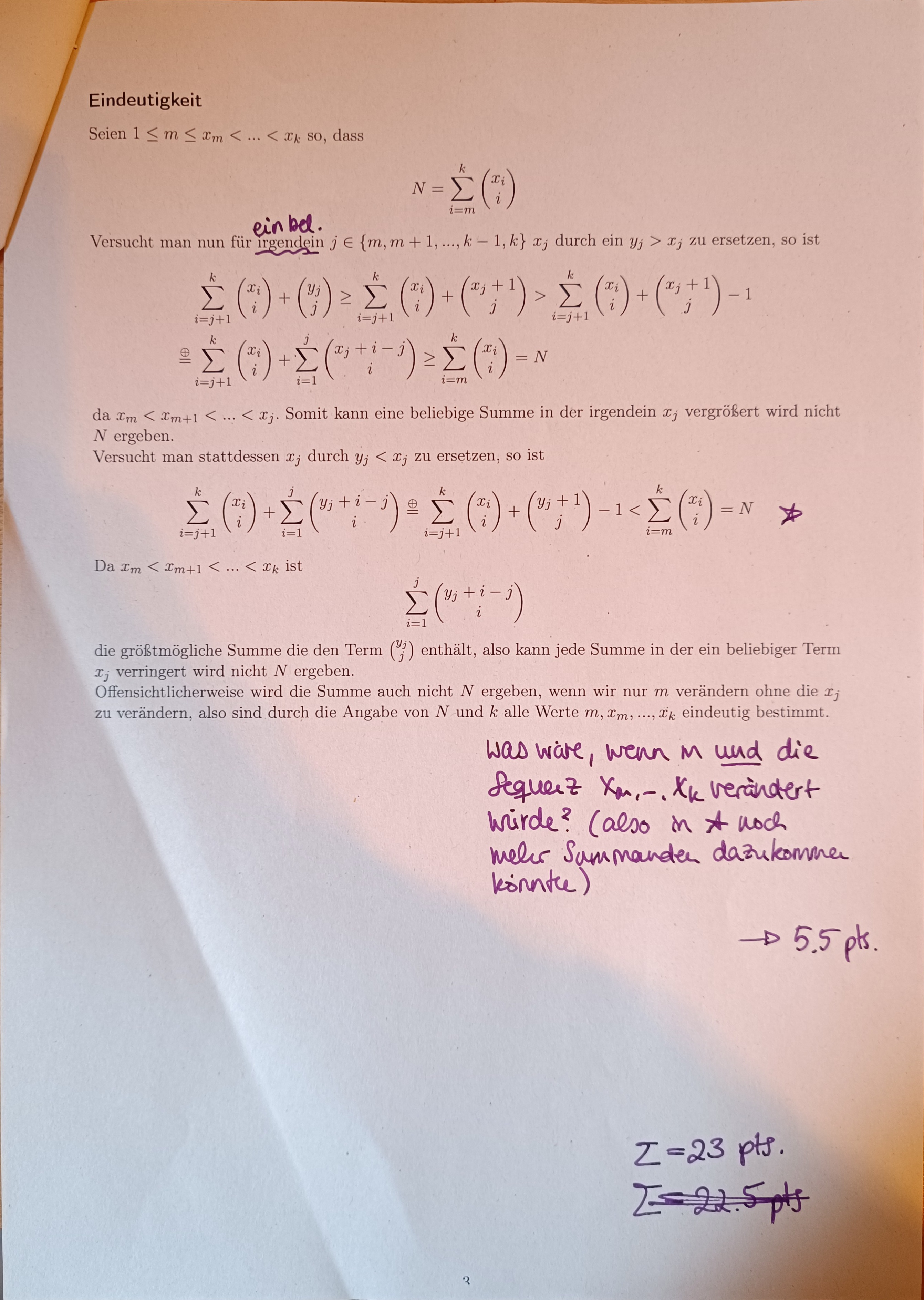
Show that there exists a unique integer 1≤m≤k, and unique integers xm,...,xk, such that xk>xk−1>⋅⋅⋅>xm≥m, and we have the decomposition