ex3-0.pdf
Diskrete_Mathematik_UE_03-0.pdf
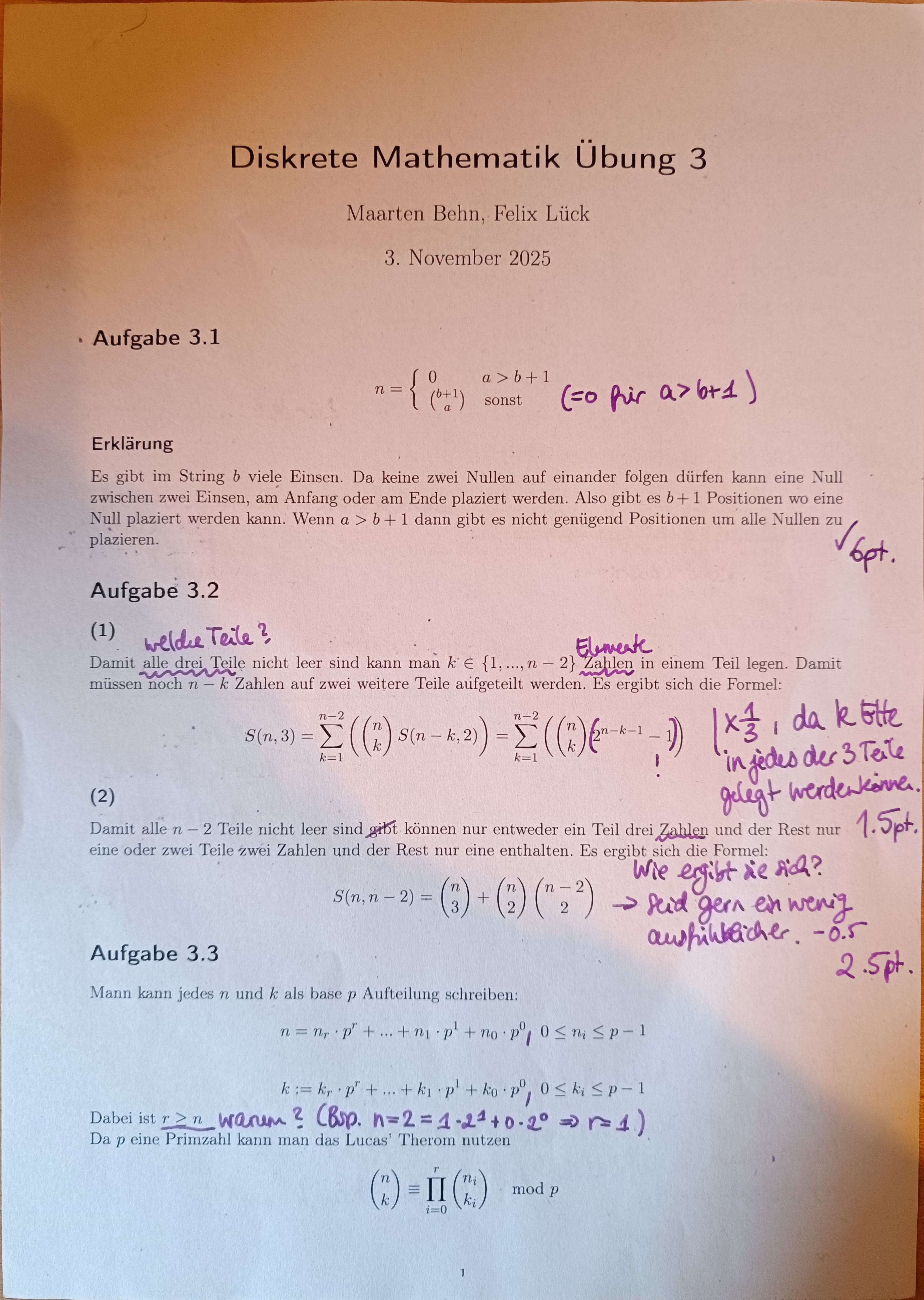
3.1
Let and be positive integers. Find the number of strings s consisting 0’s and 1’s such that
-
the number of 0’s is and the number of 1’s is ,
-
the string does not contain two consecutive 0’s.
For instance, for , there are 3 allowed strings: , , and
fn main() {
	run(1, 1);
	run(1, 2);
	run(1, 3);
	run(1, 4);
	run(1, 5);
	run(1, 6);

	run(2, 1);
	run(2, 2);
	run(2, 3);
	run(2, 4);
	run(2, 5);
	run(2, 6);

	run(3, 1);
	run(3, 2);
	run(3, 3);
	run(3, 4);
	run(3, 5);
	run(3, 6);
}

fn run(a: u32, b: u32) {
	println!("\na = {a}, b = {b}");
	run_inner("", 0, 0, a, b);
}

fn run_inner(s: &str, a: u32, b: u32, max_a: u32, max_b: u32) {
	if a == max_a && b == max_b {
		println!("{s}");
		return
	}

	if a < max_a {
		let last = s.chars().last();
		if last.is_none() || last.unwrap() != '0' {
			run_inner(&format!("{s}0"), a + 1, b, max_a, max_b);
		}
	}

	if b < max_b {
		run_inner(&format!("{s}1"), a, b + 1, max_a, max_b);
	}
}
If
<0>1<0>1<0>1<0>1<0>
⇒ gaps
⇒ choose of these gaps
n = n_{r} \cdot p^{r} + … + n_{1} \cdot p^{1} + n_{0} \cdot p^{0} ; ; ; 0 \leq n_{i} \leq p - 1
hence define $k$ ask := k_{r} \cdot p^{r} + … + k_{1} \cdot p^{1} + k_{0} \cdot p^{0} ; ; ; 0 \leq k_{i} \leq p - 1
\binom{n}{k} \mod p = 0 \Rightarrow \prod_{i=0}^{r} \binom{n_{i}}{k_{i}} \mod p = 0
\binom{n_{i}}{k_{i}} \mod p \neq 0
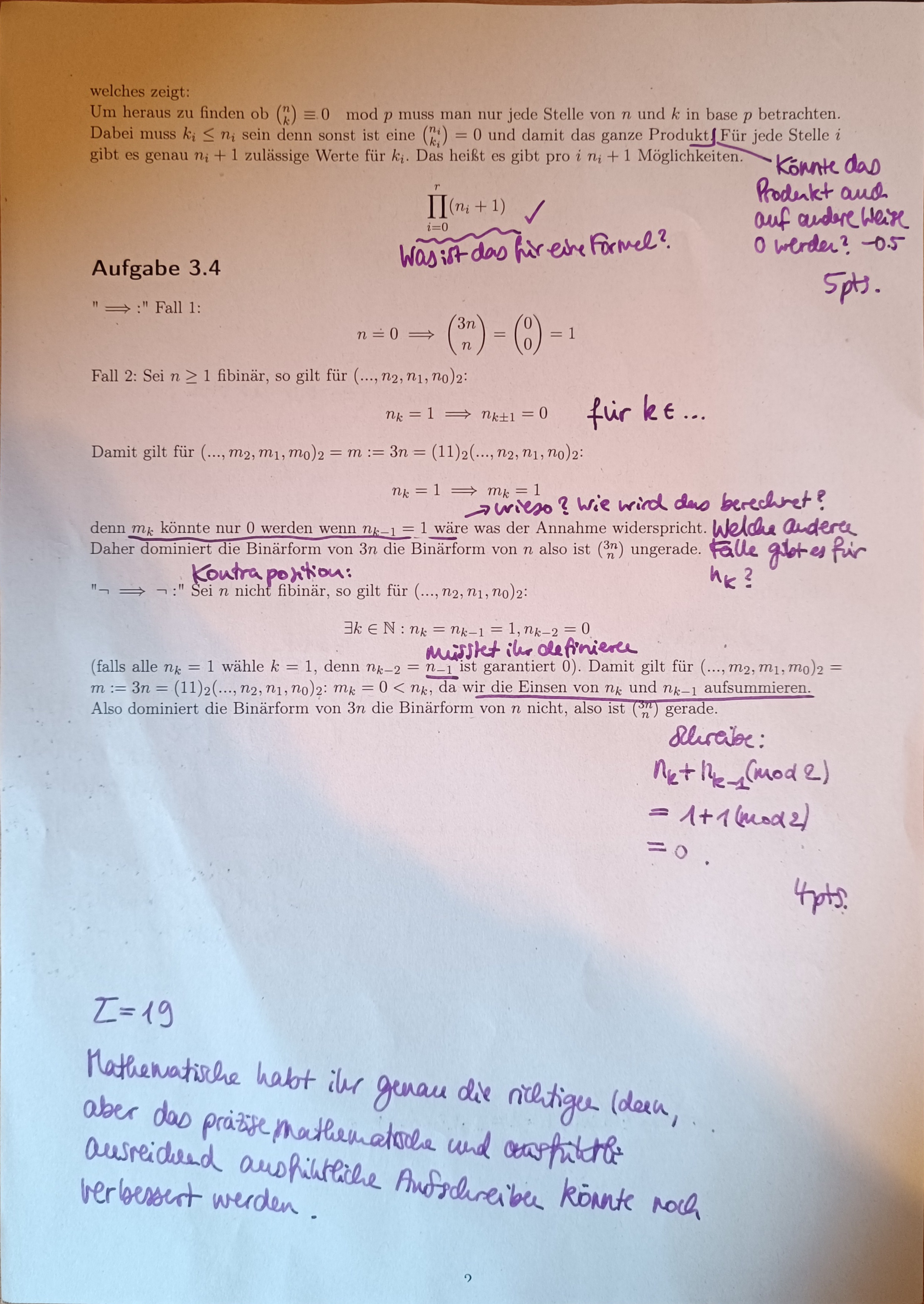
only if $k_{i} \leq n_{i}$ because if any $k_{i} > n_{i} \Rightarrow \binom{n_{i}}{k_{i}} = 0 \Rightarrow \binom{n}{k} = 0$ $k_i$ can be any value from $0$ up to $n_i$ => $n_{i} + 1$\prod_{i=0}^{r}(n_{i} + 1)