ex6-0.pdf
6.1
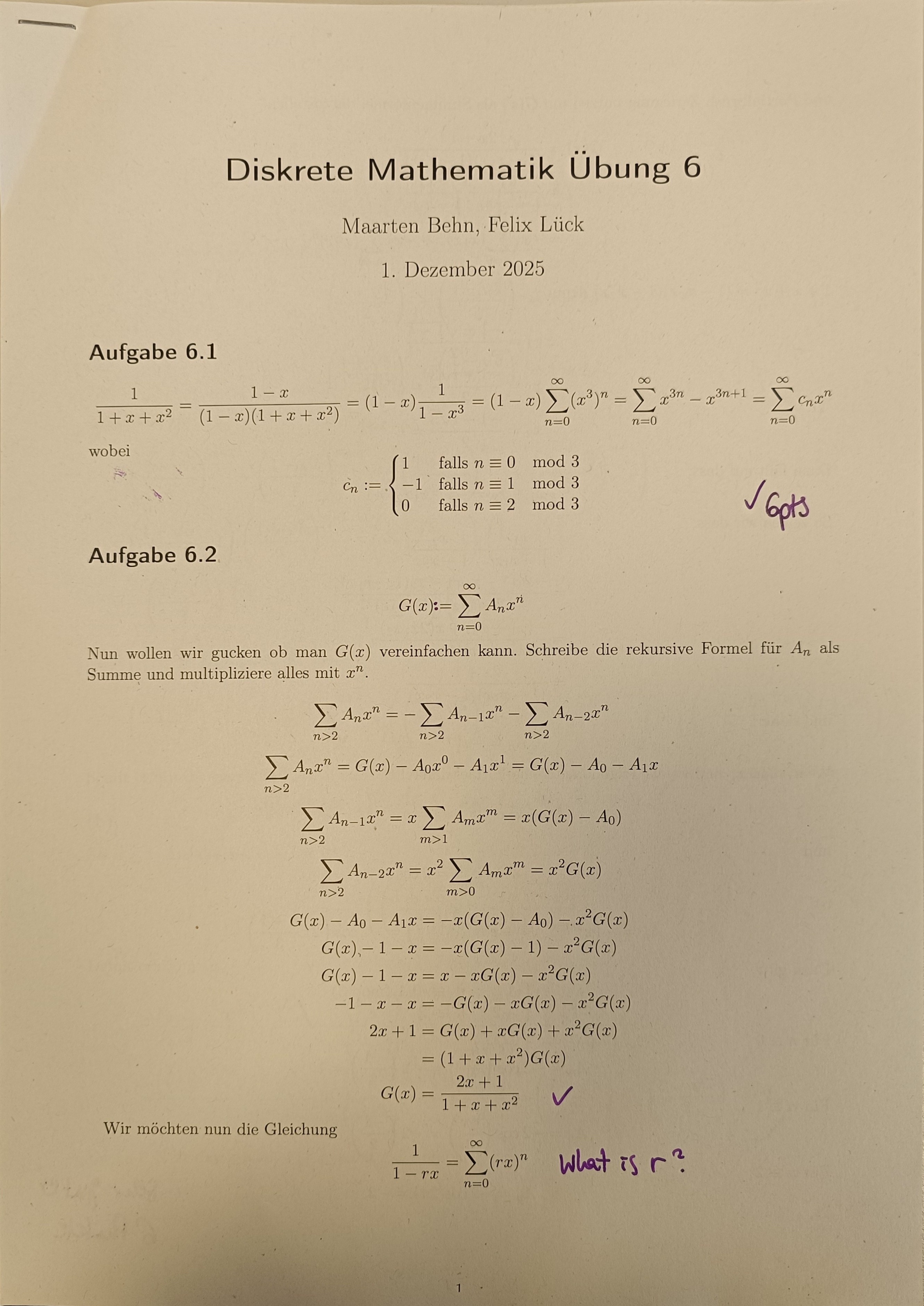
Find the inverse (polynomial) of 1+x+x2
Wir haben
P(x)=1+x+x2
nun suchen wir F(x) sodass:
P(x)F(x)=1
Wir gehen davon aus dass:
F(x)=n≥0∑anxn
dazu gilt:
an hängt immer nur von an,an−1,an−2,...,an−d mit d=deg(P(x))
an+an−1+an−2=0
an=−an−1−an−2
Nun wenn wir P(x) einsetzen
(1+x+x2)F(x)=1
sieht man das
a0=1
für n=1
a1=−a0=−1
für n=2
a2=−a1−a0=−(−1)−1=0
für n=3
a3=−a2−a1=−0−(−1)=1
für n=4
a4=−a3−a2=−1−0=−1
für n=5
a5=−a4−a3=−(−1)−1=0
… ist
Somit ist
F(x)=1−x+x3−x4+x6−x7+...=k≥0∑x3k−x3k+1=(1−x)k≥0∑x3k=(1−x)1−x31=1−x31−x
6.2
Use the method of generating functions for finding an explicit formula for the sequence {An}n≥0 given by the recursive data
A0An=A1=1=−An−1−An−2 for n≥2
G(x)=n=0∑∞Anxn
Nun wollen wir gucken ob man G(x) vereinfachen kann:
Schreibe die rekursive Formel für An als Summe und multipliziere alles mit xn:
n>2∑Anxn=−n>2∑An−1xn−n>2∑An−2xn
Probiere es als Formel mit G(x) dar zu stellen:
n>2∑Anxn=G(x)−A0x0−A1x1=G(x)−A0−A1x
n>2∑An−1xn=xm>1∑Amxm=x(G(x)−A0)
n>2∑An−2xn=x2m>0∑Amxm=x2G(x)
⇒
G(x)−A0−A1xG(x)−1−xG(x)−1−x−1−x−x2x+1G(x)=−x(G(x)−A0)−x2G(x)=−x(G(x)−1)−x2G(x)=x−xG(x)−x2G(x)=−G(x)−xG(x)−x2G(x)=G(x)+xG(x)+x2G(x)=(1+x+x2)G(x)=1+x+x22x+1
Wir möchten nun die Gleichung
1−rx1=n=0∑∞(rx)n
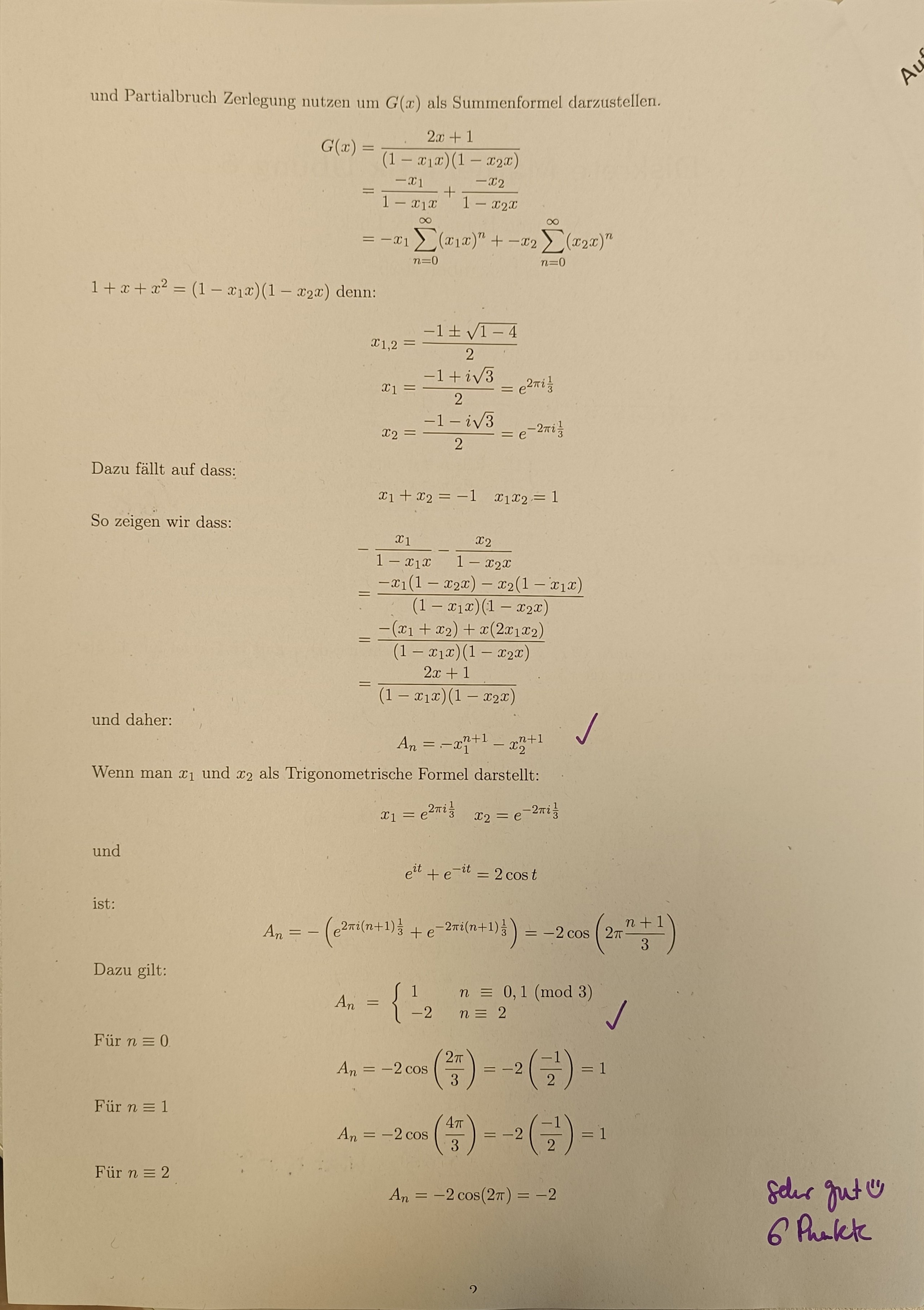
und Partialbruch Zerlegung nutzen um G(x) als Summenformel darzustellen.
G(x)=(1−x1x)(1−x2x)2x+1=1−x1x−x1+1−x2x−x2=−x1n=0∑∞(x1x)n+−x2n=0∑∞(x2x)n
1+x+x2=(1−x1x)(1−x2x) denn:
x1,2x1x2=2−1±1−4=2−1+i3=e2πi31=2−1−i3=e−2πi31
Dazu fällt auf dass:
x1+x2=−1x1x2=1
So zeigen wir dass:
−1−x1xx1−1−x2xx2=(1−x1x)(1−x2x)−x1(1−x2x)−x2(1−x1x)=(1−x1x)(1−x2x)−(x1+x2)+x(2x1x2)=(1−x1x)(1−x2x)2x+1
und daher:
An=−x1n+1−x2n+1
Wenn man x1 und x2 als Trigonometrische Formel darstellt:
x1=e2πi31x2=e−2πi31
und
eit+e−it=2cost
ist:
An=−(e2πi(n+1)31+e−2πi(n+1)31)=−2cos(2π3n+1)
Dazu gilt:
\begin{array}{ll}
1 & n \equiv 0, 1 & (\text{mod }3) \\
-2 & n \equiv 2 \\
\end{array}
\right. $$
denn:
Für $n \equiv 0$
A_{n} = -2 \cos \left(\frac{2\pi}{3}\right) = -2 \left(\frac{-1}{2}\right) = 1
Für $n \equiv 1$
A_{n} = -2 \cos \left(\frac{4\pi}{3}\right) = -2 \left(\frac{-1}{2}\right) = 1
Für $n \equiv 2$
A_{n} = -2 \cos (2\pi) = -2
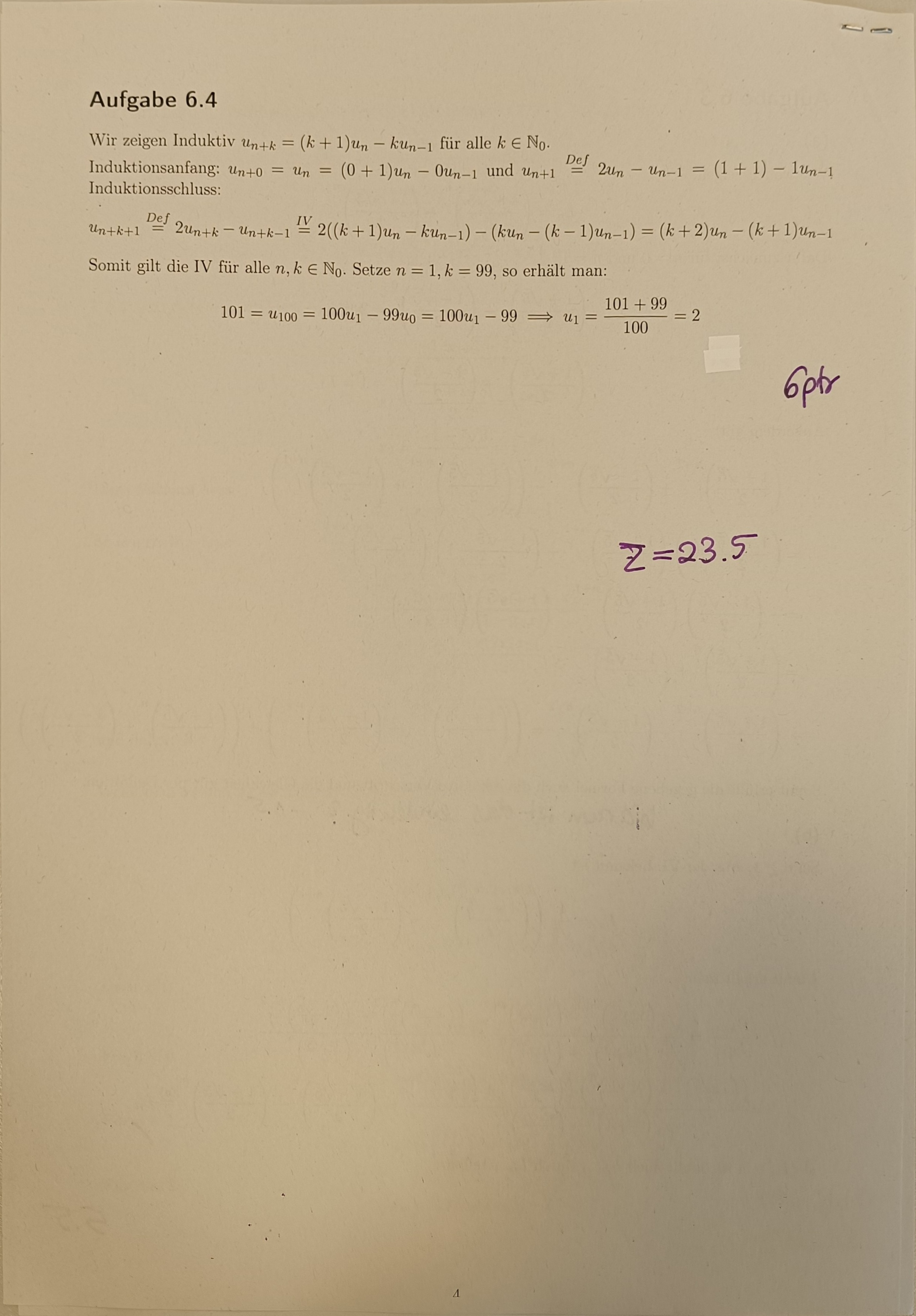
## 6.4
u_{n+2} = 2 u_{n+1} - u_{n}
$u_{0}= 1$
$u_{100} = 101$